Thursday, January 31, 2019

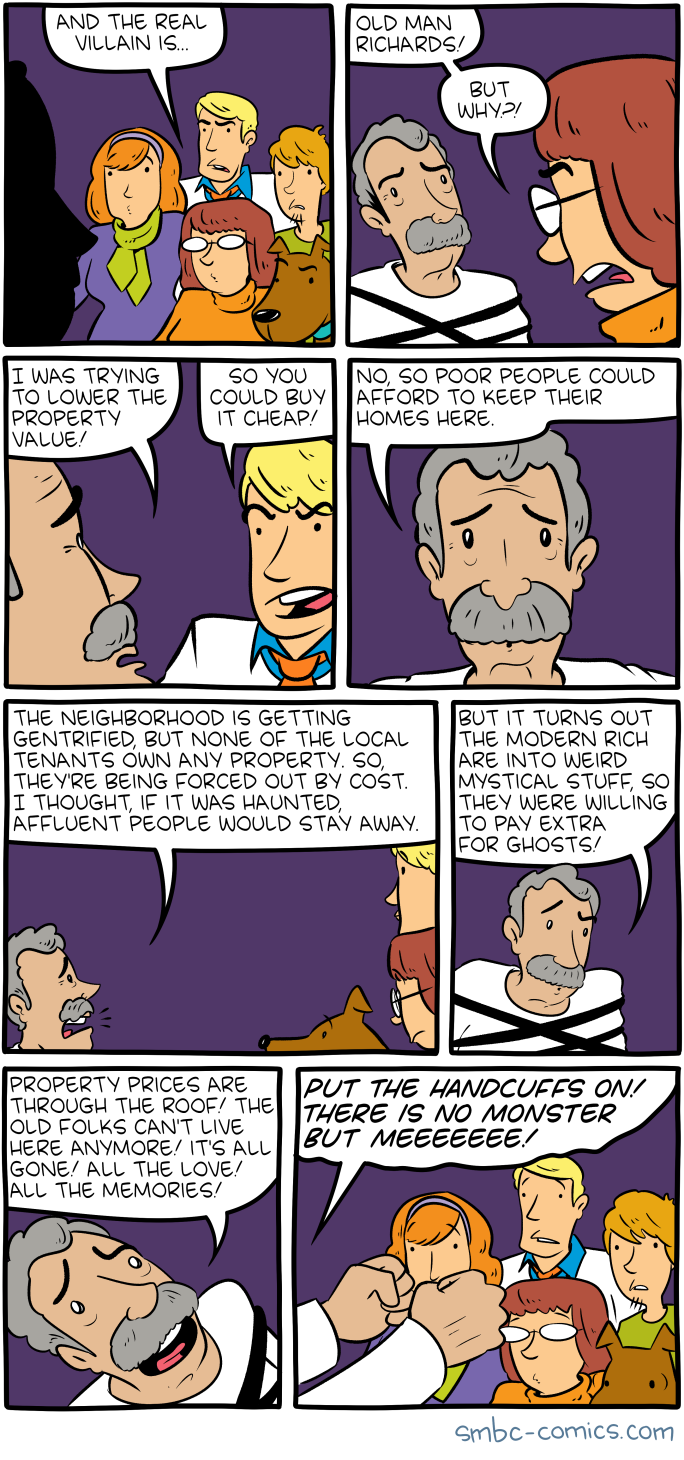
SMBC on Gentrification

Well, nice to see that my pet topic is even getting talked about in my favorite web comic :)

 https://www.smbc-comics.com/comic/the-real-villain
"None of the local tenants own any property." Yes. So what to do?

An interesting solution was brought up by CityObservatory. Planners in Washington DC are proposing to "use a combination of private investment and public funds to acquire existing housing, and maintain its availability for low and moderate income households." Instead of building public housing projects, why not take the cheaper, existing more affordable housing and use funds to keep it that way? I like it.

Saturday, January 19, 2019

Filtering and Related Phenomena

In the housing affordability crisis, it’s the lowest income bracket that winds up getting priced out and displaced, so how can we expect the almost exclusively luxury housing being built in the tightest rental markets to solve the problem? Even market-rate housing is already too expensive (see: the definition of the affordability crisis). While it may be true that high-end development alone won’t solve the affordability crisis, especially for the lowest income renters, there are several mechanisms by which it can definitely help.

The most obvious of these is tightly related to supply and demand. In its simplest form, the argument is that if you increase the supply of housing, competition for units will go down, and rents along with it. Acknowledging the spectrum from comparatively affordable older units to luxury new construction, we can still see that providing new housing for the highest income bracket relieves pressure at the next say high-middle income bracket, which in turn relieves pressure for middle income housing, and so forth. Build some high end units, and eventually some lower end units will become vacant on the other end.

The second mechanism by which market-rate or more luxury development lowers rents for all is called “filtering.” According to the Washington Post, “Filtering is the process by which, as housing ages, it becomes less desirable to wealthier residents, thereby becoming affordable to the middle class and poor.” In fact, much of what we consider affordable housing today was originally built as market-rate housing (and probably marketed as luxury :P).

It should be noted, however, that if newer units are not added to the market, filtering will not happen. If there are no newer, sexier units for higher income renters to move into, they will continue to compete for the slightly older, would-be affordable units, keeping rents high even as the units age. In this way, the two phenomena are actually one and the same. So really, filtering is the process by which "older market-rate housing becomes more affordable as new units are added to the market," (source: Berkeley IGS).

While filtering may not solve the entire affordability crisis today, with the anticipated growth of cities in the coming decades, we need to be building now if we want to have a large stock of more affordable housing in the future.

Sunday, January 6, 2019

Housing Affordability Crisis

There is a housing affordability crisis in US cities today. In his imaginative, animated article for the Huffington Post, Michael Hobbes explains the problem and its causes as one of zoning and self-interested homeowners.

He first acknowledges that city downtowns are where most high-paying jobs are located, and that most people want to live within a 30 minute commute from their work. As cities grew, “[t]hey built upward, divided homes into apartments and added duplexes and townhomes,” to accommodate the increased demand for housing near downtown. Have we just run out of room now? Not exactly... 😞

In the 1970s, likely spurred by the outlawing of explicit housing discrimination based on race, neighborhoods began using zoning and other restrictions to intentionally inflate the price of housing, to prevent poor people (read: black people) from being able to move in. Yeah. Nasty.

Maybe today people are no longer quite as racistly motivated (maybe), but arguably it is in homeowners' best interest to increase their real estate value by limiting the supply of housing. There are many mechanisms they can use to do this. Hobbes mentions requiring large backyards and multiple parking spaces, prohibiting multi-family units, or limiting the height of new apartment buildings to prevent shadows. Some techniques, like requiring extensive “design reviews” which slow down and increase costs for new development, are done in the name of preserving neighborhood character. Whether the motivation is racist, self-interested, or sentimental, the effect is the same: less dense housing gets built, the existing housing becomes more expensive.

I appreciate Hobbes’ simple illustration of housing as supply and demand, with the supply being constrained by all-too-powerful homeowners and neighborhood associations, however, among affordable housing advocates there is disagreement about whether relieving some of the constraints on development would result in lower housing costs. Since developers are incentivized to build more expensive, luxury units, how exactly will that solve the affordability crisis? And isn’t it the most affordable units that are often demolished in favor of new development? Cliffhanger??
Urbanism and Drawdown

  Last winter I read Drawdown in an effort to better understand the current landscape of solutions to climate change, and specifically how ...